
TTL;DR
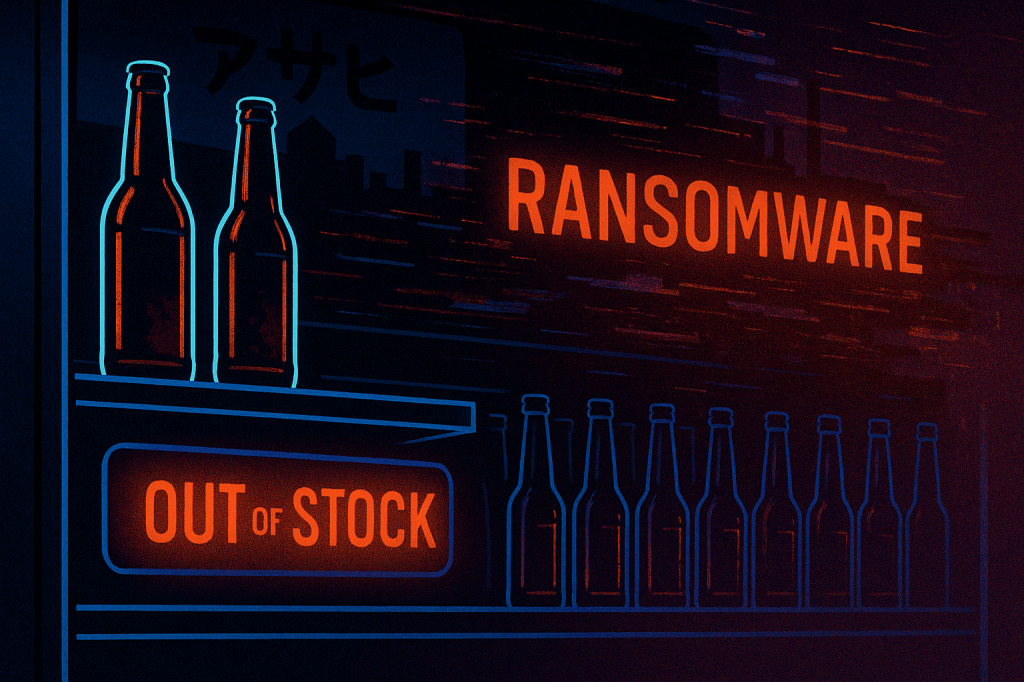
A ransomware attack on Asahi Group Holdings in Japan disrupted ordering and shipments, causing visible beer shortages. The Qilin ransomware group claimed the intrusion and posted alleged internal documents, while Asahi worked to restore systems and resume production—an instructive case of IT outages cascading into OT/supply-chain impact.
What we know so far
- Incident timeline: Asahi disclosed a cyberattack on Sept. 29 and halted domestic ordering/shipping systems; shortages were reported as operations struggled to recover in early October.
- Claim of responsibility: On Oct. 7, the Qilin ransomware group claimed the attack and posted sample images of purported internal documents; Reuters reported the claim and alleged data volumes (~27GB), though authenticity remains unverified.
- Business impact: Widespread product shortages in Japan (restaurants, convenience stores) and manual workarounds; stock movement and broader supply implications were covered by Reuters and AP.
- Ongoing recovery: Dark Reading reports Asahi restarted manufacturing and continued system restoration while investigating potential data transfer.
Why it matters
Manufacturers have thin margins and tightly coupled IT/OT. When ordering, logistics, or scheduling systems go down—even briefly—inventory buffers drain, triggering consumer-visible shortages. Ransomware crews understand this leverage and time their demands around operational urgency.
Threat actor snapshot: Qilin (high level)
- Operating model: Ransomware-as-a-service with prolific claims through 2024–2025, including healthcare and manufacturing targets.
- Recent activity against Asahi: Claim posted Oct. 7 with screenshots; reports vary on exact victim counts, but coverage aligns on Qilin’s high tempo this year.
ATT&CK-aligned analysis (likely TTPs for manufacturing)
- Initial access: Phishing, exposed edge devices, or third-party compromise (T1566, T1190, T1195).
- Privilege escalation / Lateral movement: exploitation of domain services, RMM tools, or PSExec/SMB (T1068, T1021).
- Impact: Data encryption and business process disruption (T1486), data theft for double extortion (TA0010).
- Path to OT: Weak IT/OT segmentation lets IT compromises stall production scheduling/MES interfaces.
Defensive takeaways for CISOs and plant ops
- Segment ruthlessly: Enforce L3/L4 segmentation between corporate IT and OT; block default east–west protocols; strict one-way data diode patterns for telemetry.
- Backup strategy with drills: Immutable, offline backups for ERP/OMS/WMS; perform timed restoration exercises.
- Vendor access governance: Rotate credentials, enforce MFA and PAM for integrators/MES vendors; time-box VPN access.
- Business continuity: Manual ordering/shipping playbooks; pre-approved “brand substitution” and distribution rerouting.
- Detection controls: Hunt for ransomware precursors (mass discovery, AD enumeration, shadow copy deletion) and stop lateral move tooling (e.g.,
psexec, RMM beacons). - Crisis comms: Define consumer messaging paths early—Asahi’s public updates and apologies helped frame expectations during shortages.
References
AP News: “Cyberattack hits major Japanese beverage producer, affecting its operations,” Oct. 3, 2025.L;DR
Dark Reading: “Cyberattack Leads to Beer Shortage as Asahi Recovers,” Oct. 8, 2025.
Reuters: “Asahi beers running dry in Japan as cyberattack shutdown lingers,” Oct. 3, 2025.
Reuters: “Qilin” cybercrime gang claims hack on Japan’s Asahi Group,” Oct. 7, 2025.
A ransomware attack on Asahi Group Holdings in Japan disrupted ordering and shipments, causing visible beer shortages. The Qilin ransomware group claimed the intrusion and posted alleged internal documents, while Asahi worked to restore systems and resume production—an instructive case of IT outages cascading into OT/supply-chain impact.
What we know so far
- Incident timeline: Asahi disclosed a cyberattack on Sept. 29 and halted domestic ordering/shipping systems; shortages were reported as operations struggled to recover in early October.
- Claim of responsibility: On Oct. 7, the Qilin ransomware group claimed the attack and posted sample images of purported internal documents; Reuters reported the claim and alleged data volumes (~27GB), though authenticity remains unverified.
- Business impact: Widespread product shortages in Japan (restaurants, convenience stores) and manual workarounds; stock movement and broader supply implications were covered by Reuters and AP.
- Ongoing recovery: Dark Reading reports Asahi restarted manufacturing and continued system restoration while investigating potential data transfer.
Why it matters
Manufacturers have thin margins and tightly coupled IT/OT. When ordering, logistics, or scheduling systems go down—even briefly—inventory buffers drain, triggering consumer-visible shortages. Ransomware crews understand this leverage and time their demands around operational urgency.
Threat actor snapshot: Qilin (high level)
- Operating model: Ransomware-as-a-service with prolific claims through 2024–2025, including healthcare and manufacturing targets.
- Recent activity against Asahi: Claim posted Oct. 7 with screenshots; reports vary on exact victim counts, but coverage aligns on Qilin’s high tempo this year.
ATT&CK-aligned analysis (likely TTPs for manufacturing)
- Initial access: Phishing, exposed edge devices, or third-party compromise (T1566, T1190, T1195).
- Privilege escalation / Lateral movement: exploitation of domain services, RMM tools, or PSExec/SMB (T1068, T1021).
- Impact: Data encryption and business process disruption (T1486), data theft for double extortion (TA0010).
- Path to OT: Weak IT/OT segmentation lets IT compromises stall production scheduling/MES interfaces.
Defensive takeaways for CISOs and plant ops
- Segment ruthlessly: Enforce L3/L4 segmentation between corporate IT and OT; block default east–west protocols; strict one-way data diode patterns for telemetry.
- Backup strategy with drills: Immutable, offline backups for ERP/OMS/WMS; perform timed restoration exercises.
- Vendor access governance: Rotate credentials, enforce MFA and PAM for integrators/MES vendors; time-box VPN access.
- Business continuity: Manual ordering/shipping playbooks; pre-approved “brand substitution” and distribution rerouting.
- Detection controls: Hunt for ransomware precursors (mass discovery, AD enumeration, shadow copy deletion) and stop lateral move tooling (e.g.,
psexec, RMM beacons). - Crisis comms: Define consumer messaging paths early—Asahi’s public updates and apologies helped frame expectations during shortages.
References
- Dark Reading: “Cyberattack Leads to Beer Shortage as Asahi Recovers,” Oct. 8, 2025.
- Reuters: “Asahi beers running dry in Japan as cyberattack shutdown lingers,” Oct. 3, 2025.
- Reuters: ’Qilin’ cybercrime gang claims hack on Japan’s Asahi Group,” Oct. 7, 2025.
- AP News: “Cyberattack hits major Japanese beverage producer, affecting its operations,” Oct. 3, 2025.
 redsec.ninja
Leave a comment